
Professional email signatures for real estate agents
Build a real estate email signature that makes the agent, brokerage, property link and next step clear without turning every message into a listing flyer.
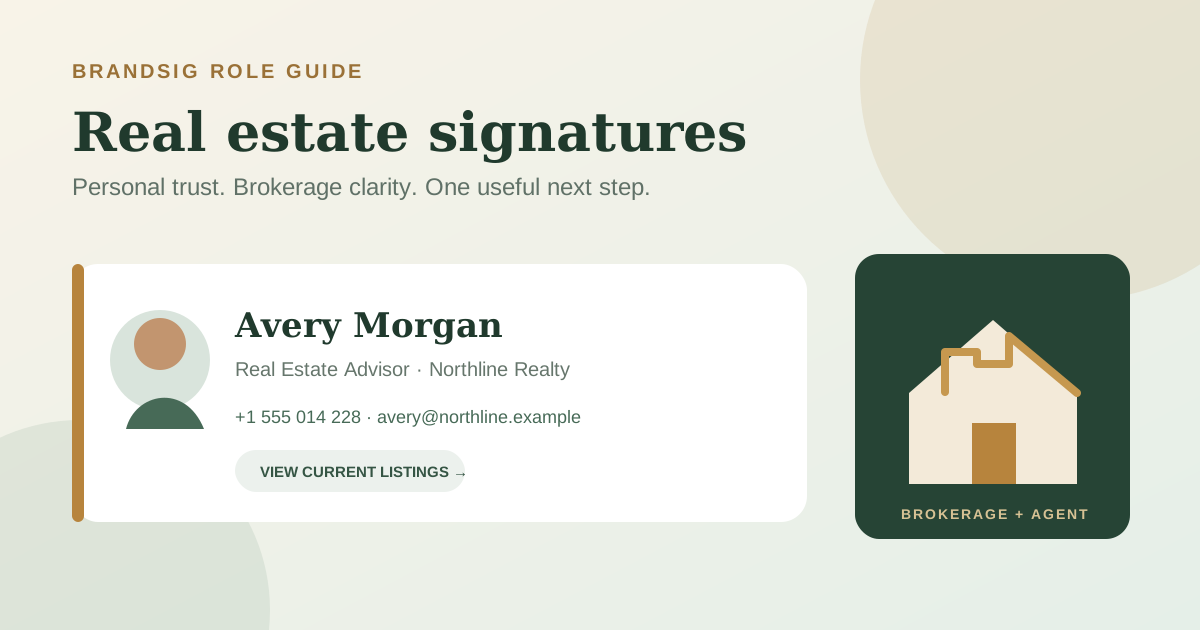
A real estate signature has to do two jobs at once. It should make a personal conversation feel trustworthy, and it should make the next step—calling, viewing a property or visiting your listings—easy. The mistake is trying to fit an entire property brochure beneath every email.
The strongest agent signatures are compact identity cards. They identify the person and brokerage first, then offer one relevant action.
What a real estate signature should include
| Element | Why it belongs | Keep it concise |
|---|---|---|
| Full name | The sender must be immediately recognizable | Use the same name as your profiles and license records |
| Role or specialty | Sets context for the conversation | “Real estate advisor” or “Buyer specialist” is enough |
| Brokerage name | Connects the agent to the represented business | Use the approved spelling and logo |
| Phone and email | Gives the recipient a direct route back | One primary number and one email address |
| Website or listings page | Provides a useful next step | Link descriptive text instead of pasting a long URL |
| Required license or office details | Supports local compliance | Use the exact wording your brokerage requires |
Requirements differ by market, brokerage and transaction type. Treat your company’s approved wording as a required field, not a decorative footer you can rewrite.
A clean agent template
Avery Morgan Real Estate Advisor · Northline Realty +1 555 014 228 · avery@northline.example View current listings · Book a property call
This version works because the agent remains the focus. The two links are useful, but neither is designed like an advertisement. On a phone, the four short lines wrap predictably and the phone number remains tappable.
Build the same structure in BrandSig, then replace the sample fields with the brokerage-approved data and links.
Decide what the single CTA should do
The best call to action depends on the conversation.
- A listing agent can link to View my listings.
- A buyer’s agent can use Schedule a property call.
- A rental specialist can link to See available rentals.
- A team leader can use Meet the team.
Choose one primary destination. A row of six badges—listings, valuation, newsletter, Instagram, YouTube and booking—makes the recipient decide what your signature is for. Most will choose nothing.
For an active property campaign, create a temporary campaign version rather than changing the permanent signature into a mini flyer. Remove it when the listing closes.
Use the headshot and brokerage logo deliberately
A recognizable headshot can help in a relationship-driven business, especially after a first call or viewing. Keep it small, professionally cropped and secondary to the live text. A brokerage logo is useful for recognition, but it should not be the only place the company name appears.
Use real text for the agent’s name, role and contact details. If a recipient blocks remote images, the signature should still identify the sender. The HTML versus image signature guide explains why a single flattened graphic is fragile: none of its phone numbers or links remain independently usable.
Keep listings out of long reply threads
Real estate conversations become long quickly. Repeating a full signature, portrait, logo and property banner under every two-line reply creates a wall of duplicated content.
Create two versions:
- A full signature for new external messages.
- A compact reply signature with name, brokerage and phone number.
Use the full version when introducing yourself, sending a proposal or following up after an enquiry. Use the short version once the relationship and property context are established.
Make every contact route mobile friendly
Most property conversations move between desktop and phone. Test the signature at a narrow width and tap every link on an actual device. The phone number should use a telephone link, the email address should open a new message and the listing page should not require a desktop layout.
Avoid wide horizontal designs with a large portrait on the left and five columns on the right. A simple two-column table can work, but it should collapse gracefully when the message is viewed on a small screen.
Common real estate signature mistakes
Too many property images. They increase the message size, disappear when images are blocked and become outdated.
A generic home-page link. Send recipients to the useful destination: listings, valuation request or booking page.
Missing brokerage information. Personal branding should not obscure the business the agent represents.
Tiny compliance text. Required wording must remain readable on a phone and in dark mode.
Every social network. Keep only profiles that are current and professionally relevant.
A different design for every agent. A team needs controlled templates with room for personal fields, not independent visual systems.
Test it like a client would
Send the signature to Gmail, Outlook and a phone. View it with images disabled, tap the number, open the listings link and reply twice. Confirm that the legal or brokerage line is readable and that the full signature does not overwhelm the actual message.
A strong real estate signature feels like a polished business card: personal enough to build trust, structured enough to represent the brokerage and quiet enough to let the property conversation lead.