Professional email signatures for consultants
Design a consultant email signature that signals expertise, keeps independent and firm branding clear and offers one low-pressure next step.
A consultant’s signature is a small credibility surface. It should clarify what kind of work the sender does and make continued contact easy, but it should not read like a condensed proposal.
The design challenge is choosing one useful proof point or action instead of attaching every credential, service and social profile to every email.
A versatile consultant template
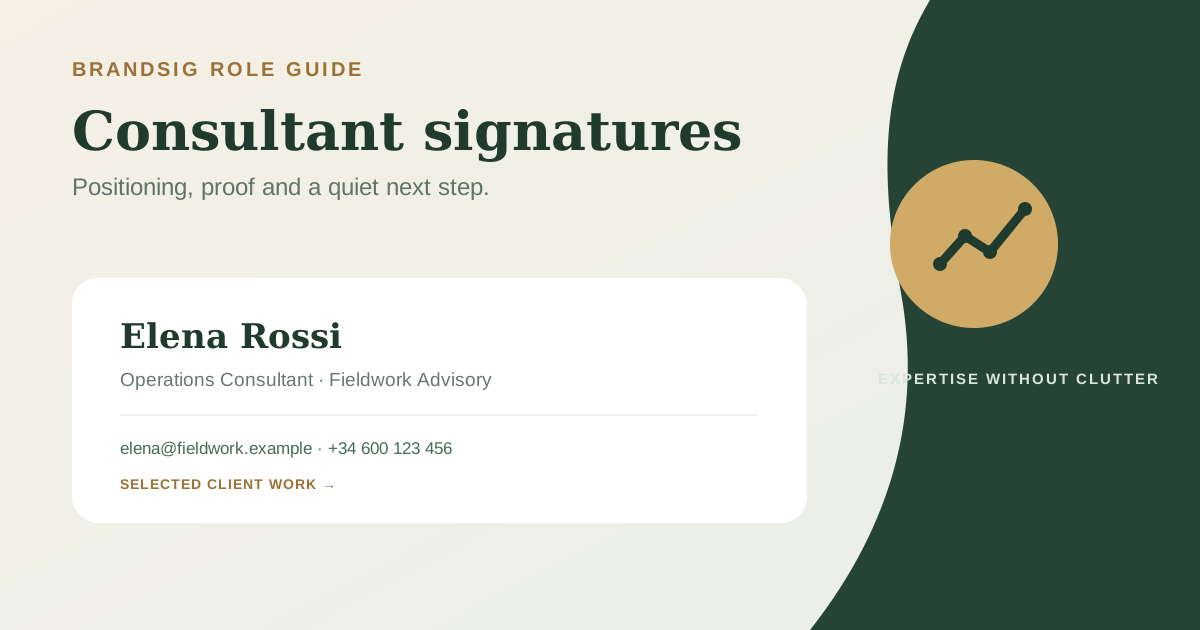
Elena Rossi Operations Consultant · Fieldwork Advisory elena@fieldwork.example · +34 600 123 456 Selected client work
An independent consultant can replace the firm line with a concise specialty, such as Pricing strategy for B2B software. Keep it specific enough to be useful and short enough to remain readable on mobile.
Build the visual version in BrandSig, then create a compact reply variant from the same identity.
Decide what should establish credibility
You do not need a client-logo wall in the footer. Choose the proof that best matches the work:
- A clear specialty.
- A relevant certification.
- A link to selected work.
- A professional profile.
- A firm website with case studies.
Use one or two, not all five. Credentials should be current, understandable to the recipient and appropriate to display in routine correspondence.
Separate the person from the firm
For a consulting firm, show the consultant’s name and role first, then the firm. For an independent practice, decide whether the brand is the person’s name or a studio name and use that choice consistently across the From name, domain and signature.
| Practice model | Recommended identity line |
|---|---|
| Independent specialist | Specialty · Independent consultant |
| Named practice | Founder · Rossi Advisory |
| Multi-person firm | Principal · Fieldwork Advisory |
| Fractional executive | Fractional COO · Independent |
| Consultant representing a client | Consultant · Firm, supporting Client |
If you work inside a client’s systems, avoid a signature that implies you are their employee unless that is the agreed representation. Context belongs in the message as well as the footer.
Use a low-pressure CTA
A consultant often needs a route to a case study, capabilities page or calendar. Match it to the relationship.
For new outreach, Selected client work or How I help is usually less demanding than Book a discovery call. When the recipient has already asked to meet, place the calendar link in the body and keep a quiet version in the signature.
One CTA is enough. If the signature includes a newsletter, calendar, services page and downloadable report, it stops being a sign-off and becomes a menu.
Use full and compact versions
The full signature belongs on introductions, proposals and new client threads. It can include a small logo, specialty and one proof link.
The compact version belongs on replies and active project conversations:
Elena Rossi · Fieldwork Advisory +34 600 123 456
Removing repeated marketing from client delivery threads signals that the relationship has moved from selling to working.
Make international details understandable
Consultants often work across borders. Include the country code on phone numbers, make time zones explicit when they affect scheduling and use an address only when it serves a real business or regulatory purpose.
Do not add five office clocks or a long availability paragraph. Put scheduling constraints in the message when they matter. If you work in several languages, use controlled language variants instead of stacking translations in one signature.
Keep links and assets under your control
Use your professional domain for email and important links. Host the logo at a stable HTTPS URL and keep essential details as live text. A link shortener or an unrelated booking domain can create unnecessary doubt when a recipient hovers.
If you use campaign parameters, label signature traffic separately and keep the final destination transparent. Never let an expired lead magnet become the permanent CTA beneath months of client correspondence.
Common consultant signature mistakes
A paragraph of positioning. Reduce it to one specific specialty line.
Every credential ever earned. Keep only the few that matter to current clients.
A motivational quote. It adds length without helping the recipient act.
A large portrait and logo together. Choose the image that adds more recognition.
A permanent “limited availability” banner. Time-sensitive claims need an expiry date.
No reply version. A full sales block repeated through a delivery thread feels promotional.
Test the signature in real work
Send it to Gmail, Outlook and a phone. Reply several times, forward the message and view it with images disabled. Confirm that the specialty remains clear, the phone number is usable and the proof link still points to a current page.
Then compare it with the actual message. The signature should reinforce a precise, confident consultant—not try to compensate for vague positioning above it.